22) Radionic Photography Today
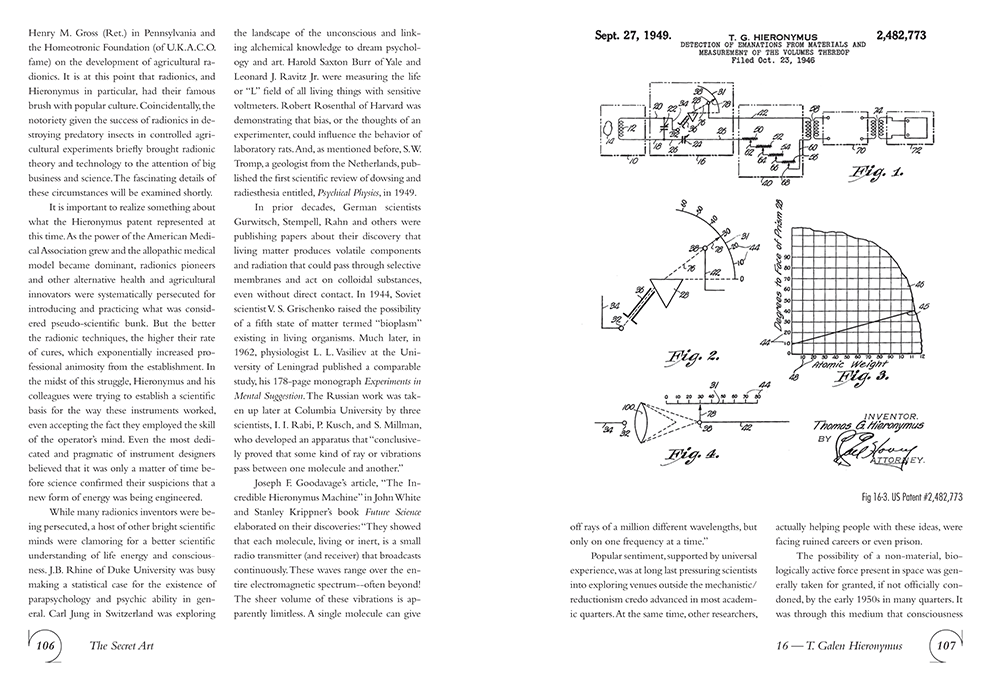
In an interesting twist of fate, just as radionics was becoming comfortable with itself as a true occult technology, new scientific information concerning the de la Warrs radionic photographs has become available.
For all intensive purposes, this sea-change begins with a paper published in 1999/2000 in the Journal of Theroetics, Inc. by a Ph.D. and RN named M. Sue Benford, titled "Empirical Evidence Supporting Macro-Scale Quantum Holography in Non-Local Effects". In this paper, Dr. Benford describes her discovery of "a spatially-encoded three-dimensional (3D) effect similar to those possible via Magnetic Resonance Imaging," on the surface of the original de la Warr glass plate radionic images.
Dr. Benford then suggests this holographic component of the photos is an indication of a macro (i.e. in our world) quantum effect, (quantum effects are presumed only to occur at infinitesimally small, "quantum" levels, and not at our level of reality).
This life sized quantum effect of the de la Warr camera also presupposes a quantum "action at a distance" (non-local) effect that is reminiscent of psi and pk events. Furthermore, Dr. Benford believes that the ability of a radionic "witness" (such as a drop of blood) to represent the organism in producing a photograph or a treatment can be explained holographically.
A holograph is essentially a three-dimensional light picture. One intriguing feature of a holograph is the property called “distributedness". Benford believes this property helps explain the "witness" phenomena. "Distributedness" means that any fraction of a hologram contains enough information about the whole hologram to reconstruct it in its entire three-dimensional form, all be it with less detail, according to the size of the fragment. By analogy, a hair or blood sample could therefore contain a holograph of the biophysical radiation of the host.
Benford sites research at the Russian Academy of Sciences* supporting the existence of this mysterious biophysical radiation. In the Russian papers, she points out this radiation is linked to physical DNA. In her words, the radiation "….may support the hypothesis of an intact energy field containing relevant organism information that is capable of being coupled to an optical imaging device", (and by implication, other electromagnetic fields).
To support her thesis, Benford quotes noted astronaut and astrophysicist Edgar Mitchell's 1999 paper, "Nature's Mind: The Quantum Hologram", (International Journal of Computing Anticipatory Systems, Volume 7, "Fuzzy Systems, Genetic and Neural Algorithms, Quantum Neural Information Processing: New Technology? New Biology?”)
"The percipient or system sensing the information, and the source of the information are in a resonant relationship for the information to be accurately perceived…. Discovery of the non-local quantum hologram created by the absorption/remission phenomenon and characteristic of all physical objects provides the first quantum physical mechanism compatible with macro-scale three dimensional world as we see it….Non-locality and the non-local quantum hologram provide the only testable mechanism discovered to date which offer a possible solution to the host of enigmatic observations and data associated with consciousness and such consciousness phenomena. Schempp (1992) has successfully validated the concept of recovery and utilization of non-local quantum information in the case of functional Magnetic Resonance Imaging (MRI) using quantum holography. Marcer (1995) has made compelling arguments that a number of other chemical and electromagnetic processes in common use have a deeper quantum explanation that is not revealed by the classical interpretation of these processes. Hammeroff (1994) and Penrose have presented experimental data on microtubules in the brain supporting quantum processes."
The keystone of Benford's thesis that combines DNA, holograms and non-local quantum connectedness at macro levels (read that as psi), is her discovery of the 3D nature of the de la Warr images. Using the VP-8 Analyzer (analogue) and the Bryce4 Software (digital) she is able to convert the image density of the original plates into a vertical relief. This does not occur when using it on a normal photograph or even on an X-ray.
The de la Warr images by contrast yield "…very accurate and well-formed three dimensional relief's…. Full rotation around the organ and/or object is possible with the digital computer software, thus permitting significantly enhanced medical assessments." Upon closer comparison with the original images, Benford was surprised to discover that the 3-D representation contained information that wasn't even on the original pictures.
De la Warr and his associates believed that their images contained a holographic element. However, the VP-8 technology needed to decode spatial information in 2-D images wasn't developed until 1976; twenty years after de la Warr published his first pictures. Twenty-three more years went by after that before Benford used her tools to demonstrate it!
What remained to be addressed in her evolving theory was the issue of operation; how did this quantum photography work? Benford's theory gets into the knotty issues of how a holographic pattern is frozen in space-time, particularly the relationship between the two optical waves that combine to make the image appear, called the "interference pattern". These two waves are called the "optical" wave and the "reference" wave. How they affect each other, the relation between intensity and phase-shifts that occurs when they cross, is what freezes the holograph in space and time in the air. Normal photographs record only the intensity changes in the optical wave. It is the phase shifts of the optical wave in relation to the reference wave that produces the added dimensionality to the image.
It will be remembered that Radionics has been described by its inventors as "pattern manipulation" at very basic levels, often involving a light-like "eloptic" energy. In Benford's theory, the reference wave originates from the "directed intention", the now familiar radionic mode of action. The camera operator puts that directed intention "in circuit" with the object wave (i.e. the object being photographed). This transaction completes the necessary requirements of creating a radionic holographic image on a 2-D surface (the photographic emulsion, which is otherwise completely normal).
To substantiate her theory, Benford references papers on quantum non-locality first proposed by Einstein, Podolsky and Rosen in the 1930's that hearken back to the very roots of quantum mechanical "entanglement"`. In addition, she adds the recent proposal of quantum teleportation (1993 that included IBM physicist Charles H. Bennett and others).
Quantum teleportation per Benford means, "Photon quantum informational characteristics can be transmitted instantaneously between two laboratories independent of space-time". In 1997, according to her paper, quantum teleportation was successfully demonstrated by two independent groups. This experiment is creatively used by Benford to support her theory that recognizes quantum holograms as "…a macro-scale, non-local information structure (That) extends quantum mechanics to all physical objects including DNA molecules, organic cells, organs, brains, and bodies….".
Dr. Benford's work calls for a paradigm shift in our thinking. She also adds to our knowledge of radionic functioning by stating: "The intention required by the operator of the de la Warr system to extract usable information from a quantum hologram forces us to conclude that evolved consciousness is antecedent in producing measurable non-local causal events."
The rigor of Dr. Benford's thesis will not be debated here. It is enough that we compliment her for the courage to approach the rancorous topic of radionic photography from an open-minded and novel direction. In so doing, we find a resurgence of scientific interest in radionic phenomena.
Fortunately for us, the inquiry did not end there. Shortly following the release of this paper, Dr. Benford joined forces with Dr. Edgar Mitchell (of the Institute of Noetic Science [IONS]), Dr Peter Marcer (of the British Computer Society Cybernetic Machine Specialist Group) and Peter Moscow (President of the United States Psychotronic Association). Together they produced a paper for the Fifth International Conference on Computing Anticipatory Systems (CASYS '01), Liege, Belgium, 2001, titled "QuantaGraphy: Images From the Quantum Hologram".
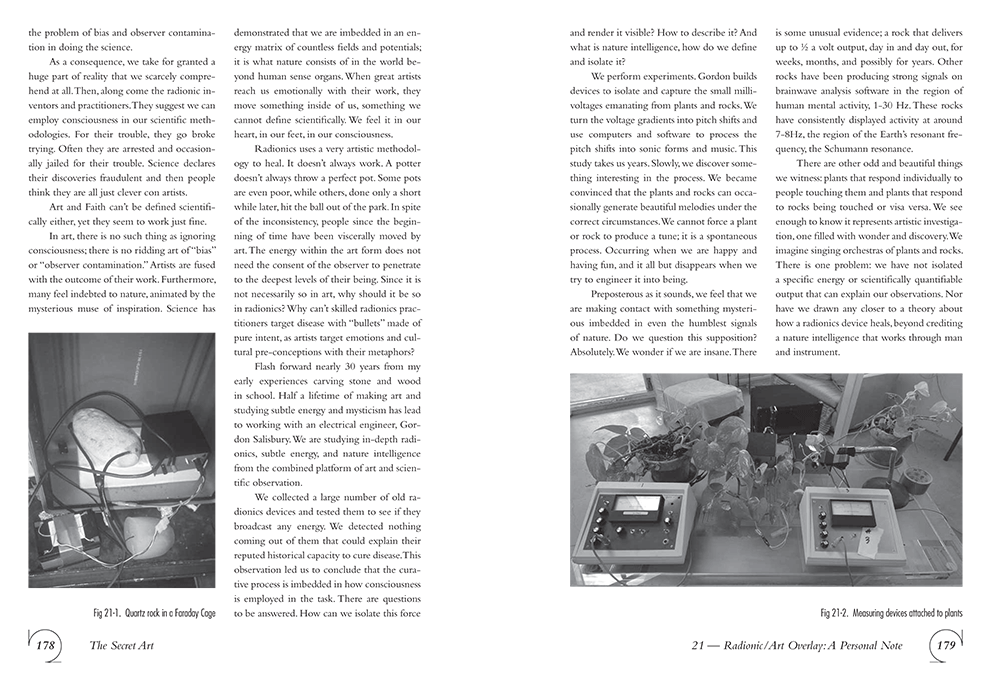
The expanded thesis took a much harder look at the de la Warr photographs and their implications for quantum theory and holography. Initially, the decision was taken to carefully examine the original de la Warr plates to determine their chemistry and composition. The Ohio State University Microscopic and Chemical Analysis Research Center (MARC Lab) undertook this work in April 2000. This investigation would also determine whether pigment had been added to the glass plate. Fortunately, that was not found to be the case, thus refuting some earlier charges of tampering.
The analysis also included using a Scanning Electron Microscope to determine the chemical composition of the glass plate itself. The same SEM was then used to examine the image chemicals on the plate, which were the standard silver-based photo emulsions that de la Warr had described using.
In short, there was nothing out of line regarding the actual glass plates themselves. The MARC concluded that the 3-D images present on the plates were probably the result of a "high energy radiation" that eluded their analysis.
Additional analysis by the group of the 3-D component resulted in a return to an earlier hypothesis. This hypothesis concluded the image was in fact similar to the layering of single slices of image that was accomplished by Magnetic Resonance Imaging (MRI) techniques. In June of 2000, a blinded evaluation of the original de la Warr images was undertaken by MRI expert, Dr. Philip Morse, Professor of Chemistry at Illinois State University. From that report:
"In attempting to explain the DelaWarr images in terms of the principles of MRI, Morse used the cow's stomach image. He commented, "The object is one dimension (wire), so bends will be reflected in the intensity differences depending on the amount of other material surrounding it. The 2-D image actually encodes the spatial distribution of the object because it is only one-dimensional in the first place, so position (location in the stomach) could be encoded by intensity. . . I'd need to see your (computer) code to figure out what you are doing. I don't see any need at the moment to postulate anything other than graphical manipulation (in the most positive sense) to generate the images you produced. However, if you are using some other method to obtain the image, then..... THAT is interesting!"
Dr. Morse believed that he was evaluating computer-generated MRI-related renderings. He was very impressed with the 3-D nature of the images, considering them even superior to ordinary MRI's, which rely on multiple images from different angles and a complex reconstruction algorithm to achieve similar dimensionality. In their summary of the functioning of the camera system, the authors had the following comments:
"The camera system consists of a trained operator, a receptacle for the test object, a control panel to adjust and ¨tune¨ the system, and a light tight compartment for the photographic plate [see Appendix I for further detail of the Camera's operational procedures] The need is, however, is to explain the most remarkable aspects of QuantaGraphs® experimentally demonstrated by DelaWarr in his creation of unique reproducible images for simple minerals, tissue, organs and organisms as already described above. The evidence presented above strongly suggests, in our view, clear parallels with the quantum holographic operation of MRI, which concerns the nonlocal quantum coherent holographic properties of matter [Binz,Schempp 2000a; 2000b] not formalized in quantum theory until the present period. DelaWarr's work would then presage and support the later discovery: - (a) that there exists in nature a nonlocal quantum holographic representation of macro-scale objects.(b) That each substance possesses its own unique and distinguishable characteristics,.(c) that spatially encoded holographic information can be "recorded" as in the case of the QuantaGraphs®, on a photographic emulsion, or indeed, as evidenced from the medical work of Abrams, on physical or biological objects, and(d) that, as with MRI, the precondition for production of a 2-D brain/body slice image, or as in Magnetic resonance microscopy a 3-D one, is one of phase-conjugate-adaptive-resonance [Schempp1992]. That is, to say, both in the Radionics of Abrams, and of DelaWarr, the brain/mind (of the physician or respectively that of the camera operator) is able "recognize" the point of resonance, which signifies the desired spectral signature, or image being sought, which corresponds to a quantum gauge condition. That is, the physician's or operator's brain/mind and sensory apparatii act as quantum holographic transducers [Schempp 1992; Marcer,Schempp 1996; Marcer,Mitchell 2000] in order to perform what is, in effect, a quantum holographic measurement. Noting that such quantum holographic measurements may indeed apply to any kind of physical field, electromagnetic, acoustic, etc; such as, in the case of Abrams, the acoustic and tactile percussing of the stomach of his patient. "
The Authors also revisited the issue of quantum non-locality, teleportation and entanglement, drawing observations from the work of Bohr, Bohm, Pribram, Aspect, Dubois, Schempp and Wilson to strengthen their theoretical assumptions. In this regard they add:
"The evidence from Radionics, therefore, suggests that the DelaWarr camera could employ quantum teleportation and utilizes both quantum and conventional information channels in regard to its operation, such that (a) the test object contains the message, and (b) the photographic plate is exposed to the new kind of energy attributable to the quantum potential Q or quantum ether. This would then explain why the camera and DelaWarr operator (and the phenomena observed by Abrams), constituting a regime of quantum measurement, do not correspond to those of the conventional classical measurement paradigm, where measurements are always, with care, totally repeatable."
In addition, the puzzling necessity to achieve the proper orientation or rotation of the subject to the Earth’s magnetic field described by various radionic inventors emerges in the paper's holographic research:
"A hypothesis in full accord with Schempp's quantum holographic, mathematical foundations of MRI, which describe the production of 2-D brain and body slice images, and in the related medical field of MR microscopy, 3-D imagery see http://wwwcivm.mc.duke.edu. In such machinery, which employs quantum teleportation so as to work [Binz,Schempp 1999], the quantum holograms so produced, do indeed consist of radiated diffraction patterns, where the holographic property of distributedness, now applies relative to a hologram plane about a resonance peak. That is, to say, such quantum holograms concern a definite orientation, both to be detectable and to be decodable, a fact highly relevant to both the diagnostic perscussive observations of Abrams, and to those of DelaWarr."
In concluding, the authors state that based upon the evidence they have in their possession, the potential benefits to medical science of radionics and radionic photography are significant enough to warrant a full scientific investigation. Without detailing the complexities of the holographic component of the theory and the means for defining and measuring "intentionality", (which is available to the reader online), their summary reads as follows:
"To posit a full theory of operation of the system, a number of questions must be fully examined: 1) What is the relationship between the test object and the subject? 2) How does the test object carry and transfer the complete information of the subject? 3) How is this information optically obtained by the DelaWarr system? The proposed theory is that the test object is a specimen from the subject that emits a complete quantum hologram, representative of the subject for the condition tested, and that such hologram represents quantum entanglement/coherence with the subject. That the quantum hologram can be caused to affect the optical part of this system through mediation of the operators focused intention; such mediation creating resonance, entanglement/coherence of the entire system, and, under the right conditions, produce a holographic-like image."
Radionic photography, in its initial analogue manifestation, did not appear to be highly technical. Many of the photographs still in existence from Ruth Drowns era did not require an electrical apparatus to work. De la Warrs work is particularly well documented and his camera(s) still are in storage or being studied.
The biggest obstacle to a recreation of de la Warrs work remains our scientific belief system. Scientism finds it impossible to believe that techniques like radionic photography actually work. Scientism has been very, very successful at suppressing research of this kind, as the history of radionics demonstrates. Should these discoveries re-emerge in an artistic platform, in a manner capable of being repeated in other studios, it would not be long before unprejudiced researchers stepped forward to scientifically examine the evidence and advance radionic photography to the next level.