02) Some Background
For many traditional artists today and going back thousands of years past, the task of art-making involved moving invisible forces. Healing, changing weather, restoring harmony, divination, accessing and making the sacred comprehensible to culture, all were tasks taken on by the shamanic artist. Since the beginning of self-reflection, artistic activity has been a bridge to the invisible world, embodying emotion, spirit, meaning and transcendence.
By examining the methodology of Radionics, I will attempt to introduce the reader to tools and ideas that explain how ancient, traditional art forms worked with energy in Nature to do work. Anthropologists are constantly reminding us that pre-historical and aboriginal peoples viewed the relationship between aesthetics and the forces of the natural world far differently than we do today. Even now, many native peoples employ the creative process for accessing subtle energy for healing and other work.
Some researchers tend to dismiss this functional and energetic component of native art as pure mythology. Only New Age true believers with frivolous, self-deceptive agendas could consider such energies as being real and immanent. Worse, many improbable and fraudulent healing devices have been sold to a gullible public for generations. No doubt there are legitimate complaints made with respect to subtle energy technology, and with good reason. Nevertheless, even valid criticisms have obscured important truths.
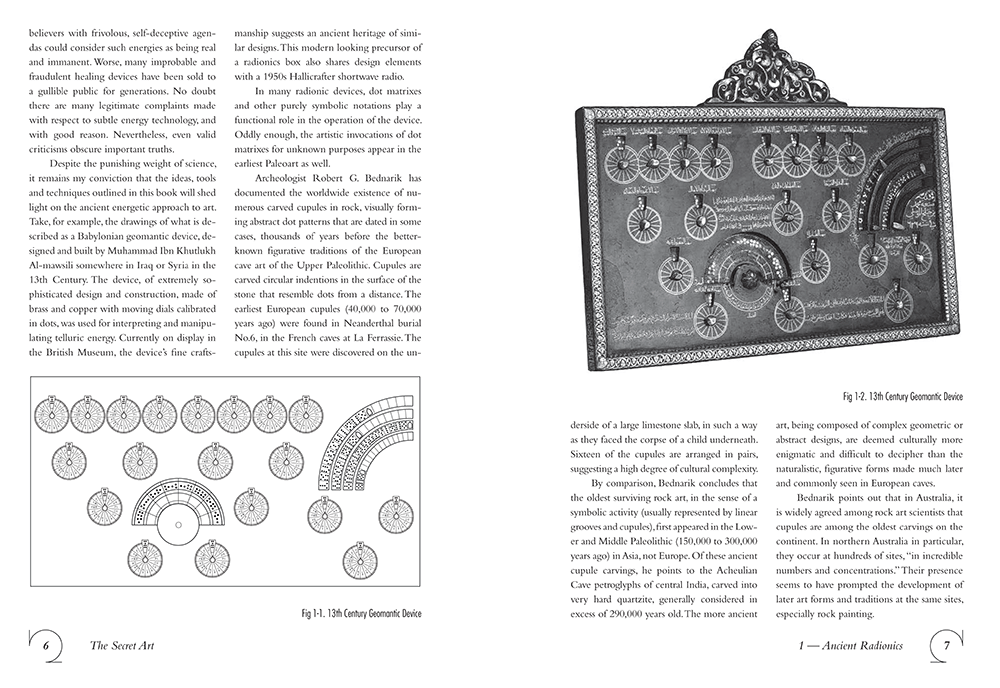
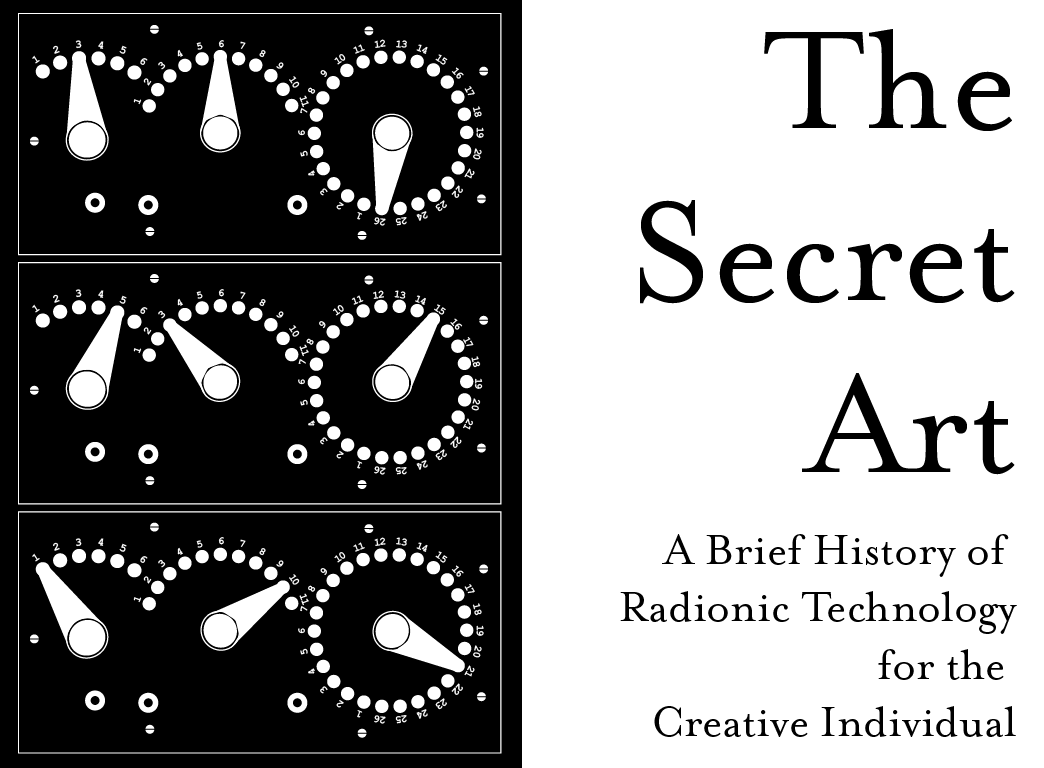
Despite the punishing weight of science, it remains our conviction the ideas, tools and techniques outlined in this book will shed light on the ancient energetic approach to art. Note the pictures of what was described as a 12thC. Babylonian geomantic device; this modern looking precursor of a radionics box actually looks like a 1950’s shortwave radio, but with the calibration in dots! Even in pre-historic eras, dots were found in many sacred sites. We don’t know why they found their way into modern Radionics, but the impression that dot patterns played a signifying role going back to the dawn of man is certainly intriguing.
Moreover, we believe the ideas and techniques of subtle energy are scientifically understood better today than ever before. In this regard, the work of one notable scientific researcher studying subtle energy stands out.
Dr. William A. Tiller, Professor Emeritus, Stanford University, Department of Material Science and Engineering holds several patents, has written four books and more that 300 papers, many of them on his avocational field, psychoenergetics, also called subtle energy.
"There is now a large body of experimental data in the general area of psychoenergetics associated with the directed focus of human intention. Remote influence experiments with healers, remote viewing experiments, investigations of psychokinetics, clairvoyance, homeopathy, and other phenomena confound the established picture of natural laws but attest to the existence of processes requiring the involvement of emotional, mental, spiritual, and other inadequately understood domains of nature.
"Because these domains are incompletely understood, they might best be grouped into a category called "subtle energies." Future research may delineate and distinguish the various characteristics of these energies and their usefulness to medicine. For now, subtle energies can be defined as all those energies beyond those presently acknowledged in physics. Four kinds of force are conventionally considered to be responsible for all the observable phenomena in the universe: the strong and weak nuclear forces, the electromagnetic force, and the gravitational force. Subtle energies and the subtle forces they generate are not necessarily strong or weak with respect to the established forces, but they are difficult to nail down with the standard protocols of today's science. It is useful to reflect for a moment on what the science of physics is able to do. Physics attempts to develop a relative framework of quantitative understanding that is internally consistent across all the various observable phenomena of nature. Physics is not able to provide absolute truth.
"Periodically, the prevailing model of physics is unable to provide internal consistency when incorporating new sets of experimental observations. The choice is then to either deny that the new observations are valid or expand the model of nature sufficiently to allow natural incorporation of the new data. Such a revision in the standard model was required when quantum and relativity phenomena had to be accounted for. Today, the majority of the physics community is in a state of denial with respect to psycho-energetic phenomena. The present model is so neat, powerful, and comfortable that many people feel it would be a shame to have to disturb it. However, evolution moves on, in spite of prevailing paradigms." (SUBTLE ENERGIES, Science & Medicine, May / June 1999, Vol. 6, Number 3)
Dr. Tiller describes six experiments dealing with directed human intention. All produced results that were inexplicable within the prevailing physical model of nature. In Tiller's view, "From these studies and many more like them, it can be seen that belief fuels expectations, and expectations in turn marshal intention at both unconscious and often conscious levels to fulfill the expectations."
Dr. Tiller’s statement suggests that design utilizing "subtle energy" proceeded from belief, which then became form through applied intent.
What much of what the ancient world considered technology; carving, painting, placement of heavy stones on the landscape, etc. we recognize today as the beginnings of art. Yet how these artworks affected consciousness, or how those artists sought to affect natural forces through them, we cannot know. However, by the study and use of consciousness technology, such as Radionics, it is possible to grasp how artistic/technological artifacts can be designed and made. Likewise, it is impossible to imagine how powerful this type of art/technology could become in the contemporary world if put into common use.
It is also important to understand why these ideas have failed to penetrate mainstream thought. Consciousness has evolved along with our needs. We respond to pressures to develop technology in response to specific economic and societal demands, often at the expense of parallel developments. Experiments in consciousness like those devised by Dr. Tiller suggest that given a different cultural orientation, education and motivation, we could be operating in a far different universe of scientific accomplishment.
The essence of our argument revolves around such a possibility. A few individuals, utilizing the alternative technologies examined in this text and others, are presently altering the basis of the way we approach design. They are evolving a creative approach to changing consciousness itself. The overview is that it will be far easier to disengage from the destructive aspects of our technology today, if we design systems for tomorrow based upon a deeper understanding of consciousness. By examining the ideas and appliances reviewed in this book, artist-inventors conceivably will be able to do just that.
It does sound impossible or improbable. Certainly many of the marvels we enjoy today would have seemed equally improbable a few generations back? Here is the rub; we have been educated and conditioned to believe the magic of consciousness cannot exist; not now, not ever. We are told consciousness is only the byproduct of chemical and electrical reactions in the brain. We can fathom our consciousness mechanically and electrically, but basically we are alone with it in ourselves. Everything in our scientific world view today stands against any truly magical technology; free energy, mind over matter, telepathy, spontaneous remission of disease, anti-gravity, and life beyond death. Yet in all instances, independent researchers report such phenomena do exist and are a matter of record, some accompanied with patents and appliances. If true, then how can they be just impossible dreams?
The simple fact is that most of our science and technology comes from a study of the world around us, from matter and natural forces, and not from anything to do with consciousness. When we evolved to the point that we needed machines that compute, only then did we really begin to study how the brain and the mind works processing signals and information.
Science has been unable to study consciousness effectively for at least two very good reasons. First, consciousness is not part of the physical, material reality that lends itself so well to the tools of scientific investigation. Secondly, in matters of consciousness it is difficult to separate the observer from the observed, which is a primary requirement of scientific objectivity and repeatability.
Art, on the other hand, has always been a discipline that is intertwined with consciousness. How can one begin to render even the most direct simulation of nature, say a line drawing of a tree, without grappling with some basic problems of consciousness? Determining how the view of the tree is selected, then rendered, involves an ability to transfer a signal from the eye to the mind to the hand. Then, there are the qualitative issues surrounding the drawing of the tree, how representational or abstract is the image; what are the aesthetics? Without due consideration to consciousness at every juncture, no human art can be made.
It would seem that artists are well qualified by virtue of the inherent demands of the profession to evaluate, design and use technology that requires consciousness to work. Under examination presently will be a number of technologies that utilize consciousness, in the form of directed intent, as the active operating force in the circuit. Ultimately, as with art, the only proof available to sanctify the methodology is the results.