
“Well if you’re reading this now, you’ve only yourself to blame; you obviously ignored the subtle warnings in part one!”
—Gordon
Is There a Shaman in the House?
They might be called shaman, priests, priestesses, mystics, healers, medicine men, or one of a variety of other names. In ancient cultures these folks claimed the ability to tap into nature’s emanations and by doing so might predict the future, induce healing, or translate the wishes of some God to the masses. Practitioners of black magic foretold the future by the throwing of chicken bones onto a table and observing the patterns formed when they landed, a practice still in use today. Soothsayers, fortune tellers, and Tarot readers use a variety of props in their quest for information on future events as do the readers of tea leaves. While we’re at it, let’s throw in the Ouija board and automatic writing. It is a bit of a stretch for me to include any of the above mentioned practices within the area of radionics but I’m sure that there are some who have either indulged in or benefited from them. I am inclined to believe that some ancient cultures were much more “tuned in” to those phenomena which contemporary sophisticates would tend to classify as paranormal or occult in nature.
I’d wager that almost everyone has at one time or another sensed a feeling of impending doom, or perhaps negativity when entering a room or joining a group of people. The hippy culture defined that feeling as “bad vibes”, a term which describes it perfectly. Sometimes we are able to sense strong feelings of acceptance or disapproval emanating from our peers without a word being said and I would without hesitation describe those transmissions as radionic in nature. The receiver in that case would be an uncluttered mind subconsciously receiving and interpreting the radionic transaction. I’m absolutely certain that if that individual had been reading or talking on his cell phone the transaction would never have occurred, and no adverse feelings detected. Reception of these tiny signals is easily derailed by interference from other distractions. Our spiritual connectedness remains universal to this day throughout all of mankind and is a true manifestation of subtle energy not necessarily linked to any religious or cultural affiliation. Man’s only limiting factor when dealing with his spirit is the overpowering crescendo of the man made noises discussed earlier. The ability to recognize those “vibes” or to manipulate our intent will eventually fall victim to that societal white noise and we will become ever more intellectually and spiritually introverted. Our sensitivity to these emanations will atrophy as we substitute artificial communication media for our own subconscious acuity. Ironically, this will happen in the name of social networking!
Take Two and call me in the Morning
Healers and others who might be described as “sensitives” could read the subtle energies which flowed from the human body and use their powers of focused intent to encourage healing. The subtle energy of our life forces provided information to healers having the power to read them, and chakra charts allowed the precise pinpointing of signals radiating from the organs and areas of the body under study. The simple act of praying over someone has been known to initiate the self healing process. Many people find relief from symptoms by concentrating on them and imagining their reduction. I tried that myself years ago in connection with migraine headaches. It proved moderately effective when just about all mainstream prescription medications either failed miserably or generated highly undesirable side effects. I have been and will continue to be a strong believer in “mind over matter” where symptoms can be relieved somewhat by focusing our thoughts and intent on an improved situation. Prayer itself is a form of focused intent and not necessarily religious in nature. Some healers focus their curative energy through the “laying on of the hands” which seems to be popular with some American Christian groups and might well be considered radionic in nature. Massage therapy and the more invasive acupuncture are two more weapons in the arsenal. We have available to us many forms of non mainstream medicine to choose from. It’s imperative to seek the advice of your regular doctor before trying these things ourselves, especially if we are being treated for other things as well.
 I had the pleasure of meeting a modern day healer from New York a couple of years ago. For the purposes of this essay, I’ll refer to him as Larry which coincidently enough just happens to be his real name. He had come, along with a couple of his students, to Duncan’s studio lab to participate in an interview to be used in an upcoming video production. When introduced, I was confronted by a middle aged heavy set black man who I’m sure sensed my skepticism about the whole healing process. I had been diagnosed a few years earlier with late stage emphysema resulting from many years of smoking, but what followed changed my mind about healers and my only regret was that we had but a limited time to work together. His method employed only focused intent and required no physical contact with the subject. During my first session with him we sat face to face for approximately 45 minutes during which he concentrated on dealing with my lung problems. His effort generated a hot spot on my back twice. That warmth was enough to produce a large damp spot in the middle of my back. He told me that he’d repeat the process later which he did. For our second session (and unknown to him) I had rigged up an ultrasonic field in the studio lab which was sampled and connected to a tone generator. Each time he focused his intent on me, the tone generator’s pitch varied slightly in response. At the conclusion of this session, my breathing had improved somewhat and remained so for a couple of days. It would appear that his concentration of mental focus was also of high enough intensity to modulate the ultrasonic field as well. Was I healed? No. Was my physical situation altered? Yes, at least during that session and for the couple of days that followed our encounter. His efforts demonstrated the radionic art at its best and opened my mind to the subject of healing.
I know, I know, it’s a Biblical quote but, I wonder if the inference there might be that the ability to do that kind of thing exists within us all. Ancient cultures believed that nature provided us with everything we needed to feed and maintain ourselves and that we had only to look around us to find it; a belief mirrored by the Garden of Eden described in the Christian Bible. Primitive man seemed to understand that nature had provided for him those things critical to life but I still wonder how this information was obtained and further how it was accumulated and promulgated by cultures having no written language. An early Native American shaman knew that the chewing of willow bark could relieve pain and reduce fevers. Did that shaman advise his patients to chew two chunks of bark and call him in the morning? Our modern sophisticated yuppie runs to the drug store and buys aspirin for the same purpose and to reduce the symptoms of his cold or hangover. We were taught decades ago by a cartoon character named “Speedy Alka-Seltzer” that the tablet’s main active ingredient was “sodium acetyl salicylate” which just happens to occur naturally in the bark of the willow tree. Our Indians (and I am forced to refer to them as Indians, since they referred to themselves as such before the invention of Political Correctness)  worshipped just about everything that swam in their waters, grew in the soil, or ran around on top of it. These same Indians (as a child I never played cowboys and Native Americans) lived a life which demanded gratitude and respect for the gifts that nature provided and thus they worshipped nature and those gifts fervently. And so, these treasures handed down by primitive people; willow for aspirin, foxglove for digitalis, and mushrooms for audio-visual special effects, remain with us to very this day helping to make our wretched lives a bit more bearable. On the down side, they also used tobacco, an addiction which granted me the gift of emphysema. Nobody’s perfect I guess.
I’ll Need a Small Sample of Your Brain Tissue
The human body generates an assortment of signals (when we’re alive of course) which can be measured electronically thus providing an excellent platform from which to launch meaningful radionic experiments. Our heartbeat is mirrored by a strong electrical pulse which is easily sampled and processed. The same can be said of our “brainwaves” except that they exist at much lower levels and these can be used to study various conditions which the body routinely experiences (sleep, agitation, relaxation, etc). One of the most useful signals produced by the body and one which I’ve explored using homemade equipment is the GSR or galvanic skin resistance effect. Cleve Backster made use of it during the development of the “lie detector”, or polygraph. It seems that when the body is at rest, our skin resistance gradually reaches a stable value easily measured electronically using a glorified ohmmeter called a Wheatstone bridge. This stable value of resistance becomes disturbed when a stressful event, either emotional or physical, is presented to the body and its value becomes lower as the level of stress increases. If the instrument is sensitive enough, the simple act of asking the subject to perform a basic math exercise (count to 100 by fives) will register a slight reduction in skin resistance indicating a small increase in his stress level as he performs the task. Asking him to repeat the count in increments of seventeen will pin the meter as he struggles for the answers to this more difficult problem. The value of resistance will slowly return to “normal” as the subject is encouraged to relax. This “normal” that I describe varies from person to person and reflects the individual’s steady state stress on that particular day. It is subject to changes occurring in the person’s immediate environment: is he comfortable, is he under emotional stress, has he had a cigarette or a cup of coffee recently? These factors and many others determine the GSR baseline values presented by any given subject. Muscular activity can also have a dramatic effect on that baseline and a subject flexing his abdominal muscles for instance will exhibit dramatically lower resistance values. The exertion of muscles in the arm could produce signals useful when studying the electrical artifacts of dowsing. Signals involving low level voltages are generated near the ends of long muscles and can be measured with an EMG (Electromyography) device. These complex signals may be tapped by placing needles into the muscle under measurement and then flexing that muscle. I did that; once! It hurt like hell but I had to try it. Just take my word for it that it works and don’t try it at home. These small signals may also be gathered by surface electrodes placed above the muscle ends but those signals are extremely small and require more processing in order to discriminate against external noise.
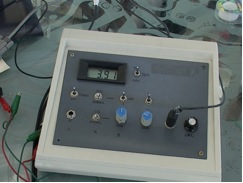 The Wheatstone bridge which I developed for use with human subjects was later adapted for use in the study of plant intelligence and both models share some common features. Of course, both utilize a meter on the panel to provide visual indications of measurements as well as a rear panel output of isolated signal voltages for feeding to a computer the information needed to produce charts. Additionally, an audio oscillator produces tones which follow the fluctuations of the signal values. These voltages and tones were used in many of Duncan’s studio productions of plant generated music. The bridge used for human measurements also includes a tracking white noise generator whose varying volume level proves especially useful in biofeedback experiments.
Biofeedback is perhaps the most underrated method of achieving an altered mental state. It is an excellent example of the radionic man, mind, machine interface and I’ve used it to great advantage in producing quality states of relaxation. I have to borrow a word here, psychophysiology, which defines the connection between mental and physical domains using external stimulation, in this case a biofeedback machine. Note that a biofeedback machine is not a healing device in and of itself. It merely provides us with the possibility of monitoring our current stress level and perhaps our success when we take steps to improve our lot in that area.
Other than epidemics and small caliber handguns, nothing has a greater effect upon our physical well being than our own mind. We are fully capable of worrying ourselves sick and frequently do just that. The stress of a demanding job or a dysfunctional relationship can eventually result in heart disease, stroke, and blood pressure problems. Even obesity and diabetes have been linked by some researchers to stress and depression. Our mainstream, profit driven medical industry is more than willing to prescribe a lifetime regimen of mind altering and sometimes addictive drugs which serve to slug down our mental processes and numb the pressures of reality in order to relieve stress. We should always, always, consult our doctors when stress becomes an issue for whatever reason, but we owe it to ourselves to at least look into the possibility of meditative relaxation methods based upon our doctor’s recommendations. That big brain perched on top of our neck is capable of improving our emotional and physical status if we just give it half a chance.
Ommmmmmmm
I’d always thought of meditation as something which required the guidance of a semi naked guru squatting at the mouth of his cave, contemplating his navel, and humming softly while in the lotus position. At my age the lotus position is no longer an option and gurus are becoming ever harder to find.
Meditation is effective. Meditation is simple, so simple in fact that you’ll find no nationwide chains of meditation supply stores. It is free. There is no need to purchase high tech sneakers or an Adidas spandex meditation costume. No religious affirmations are involved. There are absolutely no accessories needed in order to practice meditation. I’ve found that a quiet place is to be preferred, especially when beginning the practice, but in truth you can meditate just about anywhere. It is without a doubt the simplest form of relaxation therapy and one which I use frequently. Some folks use a subdued music source or a white noise based “sleep machine” to establish a radionic connection through the aural portal. Reclining on a bed or couch works best for me and even a half hour or so of meditation works magic. It’s not necessary to concentrate on a “happy place” when meditating, and truthfully, if you find yourself expending energy on concentration then you aren’t meditating! Meditation begins with the simple act of clearing the mind which at first may seem difficult. The World Wide Wasteland offers countless pages on the subject of meditation and many will try to sell you something as an aid. It’s a good idea to read up on it a bit and see how others make it work for them, but trust me, there is no need to buy anything. Chances are that someone in your own neighborhood practices meditation. You might find it useful to check with a local doctor or at your town’s library for someone versed in the art who might be willing to help you get started. It does require a little practice but the rewards make it all worth while.
Biofeedback used in conjunction with meditation can in my opinion achieve a much deeper level of relaxation but it does require the use of some electronics in the process. It has the advantage of providing the user with a measurement of his success as well as training him to achieve even better levels of relaxation. I’ve found that the use of biofeedback can also speed the user along toward a relaxed state. Once the process is learned, the machine may actually be eliminated from the loop and standard meditation procedures used. The quality of relaxation is nearly always a bit better with the machine although I sometimes feel the meditation process to be corrupted by external devices.
In practice, a subject is connected to the biofeedback device by a pair of surface electrodes, one connected to the middle finger of each hand. When the resistance reading stabilizes, a dial on the box adjusts the meter reading for zero. This will cause an audio oscillator to produce a tone of approximately 400 Hz. The audio signal may be monitored at a very low level through a speaker or headset. As the subject begins meditation, the frequency of the tone will begin to fall in pitch as we relax or rise if we become stressed, thus our subject’s task is to reduce that frequency as much as possible. The fact that he can hear the tone facilitates the learning process through the aural radionic transaction as mind and machine interact. This particular machine also offers to the subject the option of monitoring a low level white noise “hiss” rather than the tone. Some folks (me included) find the white noise more conducive to relaxation than the tone. Successful relaxation results in a reduction in the volume of the white noise as the subject strives to reduce the volume level to the lowest value possible. Beneficial brainwaves may be produced when these low levels are achieved. An additional output jack on this machine provides a voltage which mirrors the level of relaxation achieved by the subject and this signal can be used to send charting information to a computer. I’ve used a multi-channel analog to digital converter by Dataq Inc. to display up to four channels of data at once using a modest Windows based computer. These converters along with a variety of biofeedback devices may be found on the web.
The Alpha Male (or Female)
Meditation, whether you choose the simple “barefoot” method using no equipment, or the biofeedback method assisted by an electronic device, offers a level of relaxation which as I said earlier can be measured by a GSR machine. This biofeedback measurement indicates only that we have slipped into a lower value of latent stress which in itself is useful in the quest for a relaxed state. It simply tells us that we’re heading in the right direction. That information alone is more than enough to satisfy the casual experimenter. But wait! There’s more!
That central processing system under our hats has still another surprise in store for us; an assortment of signals and waves with which we can assess our current mental state with a pretty good degree of accuracy. These “brainwaves” are assigned one of four major designations.
Delta waves.. These occur between 0.1 and 3.5 cycles per second. They are present during periods of very deep sleep or unconsciousness.
Theta waves.. These are generated when our consciousness is reduced as during sleep. Their frequency varies between 3.5 and 8 cycles per second.
Alpha waves.. Alpha waves are produced during periods of physical and mental relaxation while conscious. They fall between 8 and 13 cycles per second. Our ability to learn new skills is enhanced in the alpha state and “feel good” chemicals are produced in the process.
Beta waves.. These waves occur between 13 and 50 or so cycles per second and indicate periods of alert awareness, fear, confrontation, or agitation.
The signal known as the alpha wave (recently nominated as one of the top five subtle energy emanations) is generated whenever we slip into a genuine state of relaxation and is present during that period just before we fall asleep. It is a very weak electrical wave (a sort of a, kind of a sine wave for the technically picky) which can be found on the surface of the forehead. It starts as a low level signal which comes and goes and then remains at a fairly stable level as we begin to relax. Sticky pad surface electrodes applied to the scalp are used to extract this signal and send it to a processor which converts it to an audible signal or which feeds the raw signal to a computer equipped with chart making software. Electroencephalography, (I won’t say that again) or EEG devices are used to work their magic in detecting and processing these weak signals and some years ago I built one and used it with some success. The demands imposed by those very weak signals and very strong interference sources require strict adherence to good technical practices and the use of good quality semiconductors. It’s an OK project if the builder is experienced in dealing with very low level measurements otherwise I’d recommend staying with the GSR based equipment.
Masahiro Kahata is a wonderful high energy individual who just happens to be the inventor of one of the neatest commercially available brainwave devices. He developed a device known as the IBVA which is marketed on the web from London, UK. It is not cheap and works best with the Mac but I have spent quite a bit of time experimenting with it and found the device totally satisfactory. The Dragonline studio purchased one some time ago and I did a bit of reverse engineering on it to enable its use with plant intelligence experiments. Masahiro’s device picks up its signals from a headband to which some conductive pads are applied and the device itself connects to the computer via a serial port. The software provides a remarkable variety of data display schemes and can be interfaced with other programs to generate brainwave based music. A newer version featuring more extensive bandwidth has recently been released.
Another method of generating brain waves is called entrainment and is done by using the eyes or ears as a portal to introduce two frequencies to the brain which are separated by the number of “cycles per second” that the operator wants the brain to produce. For instance, a pair of stereo headphones might be supplied with two tones, the left ear receiving a tone at 400 Hz and the right at 409 Hz. There would be a difference of 9 cycles per second and this would be perceived as a “throbbing” pulse of 9 Hz and would encourage the production of electrical waves by the brain at that “beat” frequency. I’ve been told that this is effective in generating alpha waves. My own experimentation with entrainment has been less than successful but my methods were also less than scientific so the jury is still out on that process as far as I’m concerned. Furthermore, I would be a bit hesitant when it comes to “forcing” these beat frequencies to be generated since some frequencies within the range of interest have been known to trigger epileptic seizures. I’d also be very reluctant to apply flashing lights at these low frequencies to the eyes for this very same reason. Our brain considers the eyes as just another port of entry where entrainment is concerned and users of certain video games have suffered ill effects from the flashing of the video screen at these low frequencies. Common sense should dictate that whenever you’re fooling around with pulsating light or sound sources do it with a friend.
Safety First
 As we’re beginning to see, the body provides a variety of signals which can be used in the study of radionic phenomena. I can’t overemphasize the importance of safety when connecting the body to anything electrical. There are many opportunities to become incinerated when one fails to respect the power of electricity and this can spoil one’s afternoon. I have a few suggestions regarding the safety issue:
- Always follow the instructions provided with any equipment you use.
- Never work alone. Your flyblown corpse might lie undiscovered for weeks.
- Operate everything connected to a person on battery power only and remove any accessories and cables other than those actually in use. Never have any of your instruments or computers plugged into the wall socket.
- Don’t even think about doing this stuff unless you’re skilled in the processes of electrical isolation between a subject and any power source. Learn CPR!
- Some equipment purchased on the web may be of questionable quality. Have an expert check it out for you. There is a lot of cheap imported junk out there and most “chopstick” electronics leave much to be desired.
- When in doubt, DON’T! Plants instead of humans are an interesting study in themselves and the use of a geranium might save you from a painful shock. Read on!
Plants are People Too
I have to admit that I’ve had a great deal of fun working with plants using equipment similar to that used on human subjects. Actually, it’s a good idea to stick with plants if you’re not comfortable with the safety aspect of human interfacing. Plants don’t scream! Plants don’t sue!
The use of plants as subjects presents its own set of obstacles to be overcome. The environment in which the experiments are conducted and the type of plants used can be critical as can as the condition of the plant itself. Choose plants which are healthy and well maintained. Excessive heat or cold can cause a plant to “shut down” and refuse to cooperate. I’ve worked with plants outdoors but I’d recommend that experiments be conducted in a well lit warm room. Chances are that if you are comfortable, then the plant is comfortable as well. Potted house plants are by far the best candidates and species with broad leaves rather than succulents have given us the best results.
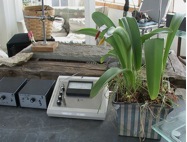 Connections to the plant can be made in several ways. The easiest method of connection is by the use of sticky surface electrodes similar to those used by EMT personnel. Ask your local emergency medical team what they use and see if there is an avenue available for you to get some. These are easily applied to the leaf surface and may be applied either as a pair to a single leaf or one each on two leaves. These lend themselves nicely to the use of the Wheatstone bridge. Plant responses can also be measured with a sensitive milli- or micro- voltmeter. Other areas of measurement may be used by placing a metallic rod in the soil and measuring between the rod and leaf surface. Slipping a pin electrode beneath the bark layer gives yet another location for grabbing signals. We have to remember that whenever moist pads or metal electrodes are used for plant contacts, that small voltages are created by virtue of the fact that the dissimilar conductors can behave like little batteries. These voltages must sometimes be factored out when measurements are made. From our own experiments with plants, the Wheatstone bridge is by far the most likely to give results and has been the instrument of choice for experimenters like Cleve Backster. The galvanic skin reaction which acted as the basis for Backster’s polygraph work is just as effective when studying plants.
Static electricity can be a problem when the air is very dry. Moving static fields can disrupt measurements and lead to erroneous readings. It turns out that static electric fields can be intense and dynamic in nature especially during the winter months when heating systems wring most of the humidity from the air in interior environments. Just the act of walking into a room causes swirls and eddies in the static laden air which are easily measured. I built an adaptation of a simple electrometer described in a web article which served admirably in observing these troublesome fields. The device gave high readings when someone walked past it wearing nylon or other man made fabrics. Running a comb through one’s hair (assuming that one has some hair to comb) can drive the meter off the scale. I constructed a much more sensitive version of the electrometer which enabled me to determine that some folks (not me however) had the ability to modulate the intensity of a static field using focused intent or concentration. I saw some evidence that this modulated electrostatic field could in some cases alter the signals produced by plants. Unfortunately the huge amounts of man made interference saturating our environment often make it difficult to gather clean signals from very low level sources. Radio transmitters, radars, and even cell phones generate fields which can bedevil sensitive equipment. We’ve always had to understand that in our experiments sometimes the most prudent path to take was to abandon that day’s work and try again another time. I have never had a problem walking away from questionable results, and once I learned that lesson, working with radionics became much easier for me.
Another lesson to be learned here is that when working with plants, one does so on the plant’s terms. There are many times when plants decide not to cooperate for one reason or another. Sometimes a neglected plant in need of water or a bit of fertilizer will shut down altogether and no amount of coaxing will pry a signal from it. Another plant in the same room and under the same conditions might perform its brains out. Plants also become fatigued and provide results at a lower and lower level over time, sometimes a very short time, making long running experiments difficult. I’ve never had the impression that any plant firmly confined within its ceramic prison, waits patiently, in breathless anticipation for me to come and connect it to some electrical gadget. Never have I seen a plant waving its fronds, leaves, or tendrils seductively in my direction hoping to be the one chosen for the day’s experiments. I’ve learned to accept the reality that despite our being passengers (prisoners?) on the same cosmic dust mote and sharing the same niche in the time space continuum, that those plants can’t give less of a damn whether I exist or not as long as I remember to water them every now and again and don’t spend a lot of time thinking about salad.
Attaboy!
Every once in a while our patience pays off and we get some really good results and these results are truly sweet when others are present to share in the experience. Duncan had invited a group of friends to visit the studio and before their arrival we had wired some plants to a pair of Wheatstone bridges and fed their audio signals to the lab’s sound system. The group consisted mostly of adults with the exception of one gentleman’s teenage son. All of the adults took turns concentrating and focusing their intent toward the plants to no avail. It seemed that the plants just yawned and relaxed in their pots until the young man took his turn. He concentrated and focused as had the others when all of a sudden the plant “woke up” and began producing wildly varying tones from the speakers. Some of the adults tried again but had no more success than they had had the first time around. The boy repeated his effort and was again rewarded with a strong response. He was the only one of the group to repeatedly establish psychokinetic connections with the plant. I am sorely tempted to consider this as a phenomenon in its own right since the best results that I’ve observed have been with young people. They consistently provide the strongest responses when the experiments involve PK effects. Adults usually have a relatively low percentage of successful experiences with this kind of thing and when they do their results are much more subtle. My own experience bears this out. Could it be that younger people have not yet developed preconceived notions concerning experiments based upon faith or suggestion and that their open mindedness allows unbiased exploration of new ideas? Have the young not yet been tainted by the pressures of adulthood and are they better equipped to accept new realities than their elders? If this is indeed the case, I would wonder at what point in their development the attenuation of these skills takes place and if there is any way to preserve or extend them. Could it be that modern man’s artificially enhanced eighty year physical lifespan outpaces the spiritual capabilities which he was designed to use throughout his Stone Age lifespan of forty or so years? Medicine and technology have doubled the length of our physical life but what of the spiritual, mental, creative, or “call it what you will” life that exists within our skulls. Is it possible that our psychic link to nature itself, that connection within our consciousness which enables our radionic transactions, withers and dies during the prime of our physical lives?
Rock On!
I’ve never thought of inanimate objects in terms of conversational partners willing to share their life experiences with me but the fact is that they are exactly that. Rocks, in one form or another, stand as witnesses, recording our planets 4.5 billion year history. Yes Amanda, the earth really, really is 4.5 billion years old. I read that on the interwebs so it must be true! We live on a planet roughly 8,000 miles in diameter which consists almost exclusively of rock and molten rock. Our domain and that of nearly every other land dwelling living thing consists of a delicate layer of organic material just a few inches to a few feet thick. Call it dirt if you must but be mindful that nearly everything that you and I and our 6,000,000,000 roommates on this little sphere need to survive is derived from it. 75% of the surface of our planet is covered by water and the vast majority of the remaining surface is too cold, too hot, too dry, or too barren to support terrestrial life and agriculture as we know it. That’s probably why those pesky environmentalists keep nagging us about pollution. We really need to take better care of our dirt!
Rocks on the other hand are nearly indestructible and their careers begin either in the fires of the planets core, or layers of stuff at the ocean floor, or sometimes as just a bunch of smaller rocks crunched together. A geologist would classify them as igneous, sedimentary, or metamorphic and as far as I’m concerned he has every right to do so but those terms tend to make my 70 year old brain explode. To further complicate the issue, some rocks (mainly the sedimentary ones) contain little bits of plants and tiny organisms, captured within when the rocks formed. Some as a matter of fact have entire dinosaurs entombed within their layers along with those chemical trace elements which recorded our theoretical collision with an asteroid some 65,000,000 years ago; the very one which brought about the end of their reign. Believe it or not, fossilized remains of ocean dwelling critters from eons past are commonly found on mountainsides far inland. Our earth is still in a state of flux and continues to evolve geologically. I’m certain that some day a few million years from now intelligent alien life forms armed with picks and shovels will uncover the fossilized evidence of our human adventures on this rock along with that thin layer of toxic waste that did us in.
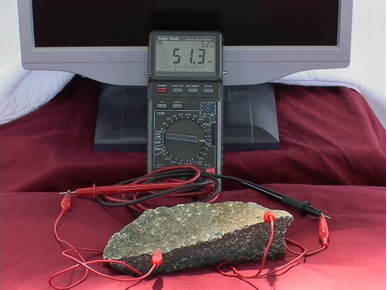
My favorite rocks though are the ones which generate tiny electrical signals. Over the last few years we’ve found quite a few chunks of common rock which produce measurable electrical currents within their structure and while most yield voltages of a few thousandths of a volt, we have one large rock at the studio which has reliably produced over four hundred millivolts for years. Surface electrodes applied to several places on the rock will usually locate a “sweet spot” where these DC voltages can be worked with. The electrical current available for measurement is extremely tiny and requires a high sensitivity amplifier with a very high input impedance to process it. Today, a good over the counter digital voltmeter can show the presence of these small signals and some have software included which can provide information for chart recording and data processing. At Dragonline we carried this stuff one step further by designing boxes which would capture these small signals and boost them to levels adequate for computer charting software and at the same time generating tones which varied in pitch with variations in the rock signals. These tones were fed into audio processing software (“Ableton Live” was most often the software of choice.) and used to selectively generate musical instrument sounds. We noted that occasionally a rock which “heard” the tones produced by its own voltage would generate shifts in pitch as if producing a radionic transaction through feedback. Connecting a plant to a Wheatstone bridge as described earlier frequently produced similar effects. By allowing a rock and a plant to experience the tones generated by one another, a unique “music” was sometimes observed which I referred to as the vegetable/mineral concerto. We also noted that our own focused intent was sometimes able to cause small changes in the output of certain rocks as well. I imagine that someone will eventually crank the human factor into this mix and use biofeedback to control and reveal the radionic transaction between man, plant, and rock. Sounds like a good experiment to me. Rock on!
ESP
Another hot button issue sure to raise eyebrows is that of extrasensory perception. Unfortunately, we’re all exposed to the Sci-Fi psychics along with those on the afternoon TV talk show programs. Mme. Crystal and the like are an obvious dose of fakery designed to sell some advertiser’s products to a gullible TV audience while filling 15 minutes or so of airtime. She’ll gush forth a prediction that some audience member’s son/daughter will marry someone rich or famous or possibly that she’s in contact with folks from beyond the grave. The audience will applaud vigorously when that big light comes on; you know, the one that says “APPLAUSE”.
 I have to state here and now that I’ve been witness to a couple of folks who did some interesting mental gymnastics with ESP. One was a young fellow I met in the early 80’s, a very kind, intelligent man who was unfortunately afflicted with severe and chronic alcoholism. He had told me on several occasions that he had been able to “read” his sister’s mind and that they had been very close as young children and shared that ability. She had taken her own life a few years earlier, an experience which further contributed to his drinking problem. He remained curious about their ESP experience and told me that they had played a game using cards; she’d choose a card and he’d try to guess it. His description of the game indicated that he guessed correctly much of the time; way too much of the time. It sounded to me as if a children’s guessing game was far from scientific and so I set up an experiment using a deck of playing cards but we had very little success with it. I did notice that on those occasions when he chose the correct card it was always a number card and not an ace or face card. As a matter of fact, he never did guess a face card in any of our experiments. The simple act of writing the number “1” with a marker on the ace woke it up and allowed its use as a number card. I modified the game so that I used only the number cards of the same suit and concealed the ten cards in a large paper bag. Choosing a card and looking at it through the bag’s open end, I’d concentrate on it and he’d make his guess. He chose correctly nearly 20 percent of the time which was beyond remarkable. I even placed a cardboard carton over the bag of cards and chose the card by peeking through a narrow flap in the carton with the same results. When I used cards of different suits, he still chose the numbers as before but nearly never could he guess the correct suit. Intoxicated or sober, blindfolded or not, his results were always about the same. When it was my turn to guess, I never achieved more than the anticipated 10 percent, and usually less. We tried several variations of the game over a period of a year or so using colors, shapes, and images, but it appeared that his ability was limited to numbers. I’ve never seen anyone duplicate that achievement. Sadly, his life was also cut short by his own hand in December of 1983.
A Shameless Product Endorsement
A more complete examination of the history of radionics along with an artist’s eye view of the subject will be found in the following publication, which served as my inspiration to write this essay in the first place.
A Brief History of Radionic Technology for the Creative Individual”
By Duncan Laurie, 2009

 A green-shaded bankers’ lamp illuminates his roll top desk behind which a half-acre or so of bookshelves offer him leather bound editions of his favorite reference books. With a flourish, those freshly flexed fingers begin their journey across the keys of his freshly oiled Underwood typewriter, a journey already fixed in his mind, one which will reflect his impeccable preparation and dedication to the literary arts. He’ll carefully create a foreword, which will guide his readers into the subject of discussion and deliver a clearly defined map of his thoughts for them to follow through his text. The man is a master of his craft. He begins.
 I’ve assigned myself the task of writing a short foreword introducing the subject to be covered by the essay that follows. Unlike my Cardigan clad friend described above, I’m sitting in a plastic office chair before a cheap IKEA assemble it yourself particle board desk. My current attire consists of a pair of boxer shorts, black, with stylized orange bats all over them. I really didn’t know they were bats until I got them home and put my glasses on but I’m OK with bats so it’s no big deal. (Photo on request.) My weapon of choice is a nearly decade old Windows computer whose operating system has developed a mind of its own of late, and occasionally demands a restart to relieve its Alzheimer’s symptoms. The successful completion of my self appointed task is further complicated by the fact that I have no idea in Hell where this essay will lead. Unlike my organized Underwood owner friend, it’s almost a certainty that you the reader and I the writer will discover the path this essay takes together. By now, you’ll have noticed that nowhere have I mentioned anything about radionics in the foreword, nor do I intend to. That is one of the privileges of being the author. Let’s just get started; fasten your seat belt and lock your tray table in the upright position.
 By this time you’ve probably observed that my interests were encouraged and nourished by the efforts of others, many others, and this is how it should be. Once helped and mentored, we are obligated to do what we can to help bring others along when they express similar interests. Age 16 was a milestone for my interests with the gaining of my first ham license in July of 1957 and the launching by the Soviet Union of the Sputnik satellite that October. I saw Sputnik (or perhaps its booster) pass overhead. I heard its “beep, beep”, beacon on a shortwave radio on 20 MHz. Jeeeezus!! These events were my first “eureka moments” in technology and directed my interests forever after. Today we’re more than a half-century removed from those events and vacuum tubes, except for some special purpose types, are pretty much relegated to the bone yard as are those of us who relied on them. Now we have over 500 channels of television to choose from, millions of web pages to peruse, and electronic games to save us from the physical exertion of the real thing. Our world has become sterile, but maybe, just maybe, something will happen to attract the interest of some sixteen year old and give him or her the same thrill that I had listening to those first few feeble seconds of Sputnik’s voice as it heralded a new era of exploration. Consider this for what it’s worth: from the first powered flight of the Wright brothers to the lunar landing, only 66 years transpired. What a thrill it must have been to have witnessed and remembered both of those events within one’s own lifetime, and there were many who did just that.
 A spider has taken up residence in my room. He/She has chosen a fairly protected spot in a corner where the ceiling and wall join, a location safe from the end of my vacuum cleaner and dust rag. In fact in order to get at him/her I’d have to remove the rug attachment from the machine, which is a pain in the rear end and so, I do my housekeeping chores and take the occasional futile pass by his/her web/nest. The attachment is just a bit too large to get into that corner spot and I chalk it up to a bit of Darwin-esque good fortune on the spider’s part. I suspect that to be true since I have successfully sucked up many not as well protected spiders into the Hoover vortex of doom along with countless dust mites, fly carcasses, and lint balls. It seems to me a waste of time to dismantle the instrument of death for just one spider, so for now his/her voluntary act of selective adaptation assures his/xx its survival in my little room and as of this writing the guest arachnid remains unsucked. You’re probably wondering by now exactly what all of this has to do with radionics and I have to admit that I’ve momentarily lost track of things myself. You’ll just have to be patient while I take a moment or two and sort all of this out. This might be a good time to grab a drink and a snack. OK, back to our spider. It’s pretty safe to say that the survival of our eight-legged friend was in no way due to any conscious effort on its part so to do. It was merely the luck of the draw that so many perished in my tornado of death while he/she was allowed to survive and flourish in that little web. Evolution played no part here and neither did intellect. There were no spider oriented reference books describing how best to choose a nesting site nor did a doting parent take the little spiderling on one of its eight knees and explain that location, location, location, is everything. Young spiders, like human adolescents, have to learn everything the hard way and in common with most adolescents, spiders seem motivated only to eat and breed. My spider sees the television set running from across the room and its many eyes absorb many times the visual content that human eyes would, but I’m certain that if polled, my spider would display no product or brand name preferences or political leanings resulting from the nearly constant barrage of commercials and commentary. Further, I don’t think that spiders have hopes, dreams, or even a basic appreciation of past and future. No consciousness or self-awareness permits it to awaken in the morning and declare “hey, I’m a spider and today I’m going to be the best spider that I can be.”
  It can only follow in the eight leggedy footsteps of its ancestors and dedicate its bland existence to finishing that damned web and producing hundreds of tiny offspring which I’m certain will hatch some morning and scare the crap out of me. The next sound you hear will be the vacuum cleaner!
  When we sleep that wonderful processor scales down our physical activities, directs our healing needs, entertains us with dreams, and makes sure that we don’t wet the bed (very often). Even in this standby mode the brain is ever vigilant; ears hearing, nose sniffing, always ready to awaken and respond to any threatening change in our environmental status. The body can be prepared by an internal program for flight or fight at a second’s notice. We can sustain injuries and the brain will reduce blood flow to affected limbs and organs wherever possible. Self preservation at its best! All of this computing capability is estimated by some to consume the equivalent of 4.5 watts of electrical power. Oh, lest we forget, there is the small matter of memory. We’re endowed with a memory that for many folks can store decade’s worth of information and experiences. I can instantly call up one of my first memories of an uncle tossing me around while celebrating the end of WW2 in 1945 (I was four years old). Horns blew, bells rang, whistles sounded, and chaos in general ruled that day. I can recall my first day of school in 1947, pets that I had, the living room radio (a Philco), and sounds, sights, and smells dating back 65 years or more. Some memories are in color, some monochrome. I wonder how much “ram” an electronic computer would require to store that much information. Now (at the age of 70) there are some memories, which have faded over time, some deleted by trauma, and some as fresh as they were at the time they were made. But the miracle of memory itself pales when we consider what we can do with it, and the portals, which open when memory and consciousness join forces.
 Yes, I’ll have the fries because I remember that I had them once before and they were freaking awesome. My choice maximizes my potential for an enjoyable fast food meal. The alternative to this method of selection would be a dart thrown at the words “yes” and “no” or the tossing of a coin. Choice can also have dire consequences when misapplied. I don’t think I’ll wear that motorcycle helmet today… or… let’s do it just this once without the condom. Anyway, it all boils down to privilege and responsibility. Yes, the freedom of choice is a precious gift tempered by the responsibility of accepting the consequences in the event that we make the wrong one. The power of logical choice is one of the things, which make us human. The choice we make, be it path A or path B in social settings establishes us as individuals; we don’t all make the same choices. When enough of us make the “right” choice then society as a whole succeeds. Enough “wrong” choices can trigger our drift toward oblivion. Gazelles have never learned that it’s dumb to drink their water from the place where the crocodiles hide. The immensity of their numbers has helped to protect them from extinction. This characteristic is one that they share with my spider. Humans however, may be the first species allowed to make voluntary choices, which might lead to our eventual destruction while the so-called lower life forms enjoy a measure of protection based upon a pre-programmed physiology and the denial of conscious choice. Let’s come back in a million years or so and see who is still at the party.
 The road to Hell is paved with good intentions. I think I read that on a wall tapestry somewhere, and if the daily news stories on my television set are any indication of the condition of that road, then we are in the midst of a major re-surfacing project. Consciousness becomes an active process when we enter the world of intent. I like to think of intent as the conscious and deliberate act of cocking a gun which we’re preparing to fire. Intent is a powerful example of consciousness; we’ve considered what we are about to do and we’ve prepared that weapon for firing. Only the act of pulling the trigger remains. We’ve reached a point where a choice, based upon our understanding of the benefits or possible consequences, can be made resulting in something we shall do in the short-term future, or the immediacy of something we WILL do now. In other words, we’ve momentarily bypassed many of our brain’s current activities and focused our conscious energy into the execution of a single powerful thought process, one that could result in a physical action. We are now in the “warp drive” of conscious effort concentrating as much of our brain’s resources as possible to this single packet of thought, this willful and focused intent. Welcome to radionics. Oh yeah, BANG!
 Some practice the craft using nothing at all while purists might choose a divining rod of hickory or willow wood. In most cases, the dowser records a “hit” when his hand or his rod is pulled downward signaling that he is over a water source or anomaly in telluric energy. I’ve seen this method used several times and frankly I don’t understand how it works. Students of the craft believe that subtle energy emanates from the earth above sites rich in water and the variations in the strength of these emanations can give an idea of the depth of the aquifer to those having the gift of that sensitivity. I had an opportunity to observe a diviner in action and rested my hand on her forearm as she worked. Her arm tensed as she passed over what she considered to be a source and I could definitely feel a flexing of her muscle when she recorded a hit. She also used metal rods, which registered hits when they turned from parallel alignment to a crossed configuration. This did not result in any muscle action that I could detect, and when it became my turn to have a go at it, I failed miserably. Some dowsers are able to work their magic by dowsing over a map using a pendulum or stick thus remotely locating water sources. I’m pleased to recommend an excellent book describing the career of an American practitioner who pushed the envelope of the craft to its limits:
 I sometimes wonder if we (and the rest of life in general) might have been better off had we remained at the knuckle dragging stage when a hot date consisted of harvesting lice from each other’s backsides on a Friday night with our newly evolved opposable thumbs. But evolution, being what it is, could not leave well enough alone and in walked Homo sapiens, man, with his hat on backwards, his hand in his pants, and a boom box on his shoulder. Hands up if you think that evolution might have hit a bump in the road here. This would be my proof that God does indeed have a sense of humor. Enough of that!
  Vinny and Doreen showed up as the first examples of man v.1.0. I don’t want to wax biblical here, so we can either believe that God created them instantly, that they evolved from some manner of narcissistic great ape, or that aliens, sick of their intergalactic back seat driving dropped them off in the African Rift Valley. Believe what you will, the choice is yours. Personally, as a devout former Catholic, I tend to believe that the forces of evolution by natural selection were the most powerful and majestic tools given by God to insure the success of his creatures. Maybe that’s why I’m a Hell bound, terminally excommunicated Catholic but that’s another story entirely. I truly feel that Charles Darwin got it right and we’ll take a break here with one of his quotations, which seems to sum the whole thing up.
  For the record, Doreen proved so irresistible that Vinny reformed and began dating only within his own species. Night after night they sat on a rock admiring each other’s wonderful opposable thumbs and inventing new uses for them in the pursuit of whoopee. Generation upon generation of these terrestrial newcomers played house, multiplied, and developed little bits of technology to prevent themselves from being eaten, freezing to death, or dying young. They made shelter, clothes, and campfires, hunted game when they could, and ate what they found in the forest. Nature offered them pretty much the same risks and benefits that she offered the rest of her creatures, and these hunter gatherers lived a nomadic life pretty much in sync with her laws. Nature’s intelligence dictated that life for them would be difficult (and short) but that a manageable population could thrive in concert with the rest of the plant and animal kingdom and that she would provide an adequate level of nourishment for them. In other words, mankind could, in a co-creative relationship with nature, establish a flourishing though simple lifestyle while maintaining the environmental and ecological balance that Mother Nature demanded. The Vinnys and Doreens of this world would live on a par with the rest of the creatures; no better off, no worse. This hardscrabble utopian lifestyle skidded off the track at about the same time that Doreen read of the luxuries described between the covers of “The Neolithic Times”. Her lust for real estate and the concept of community property soon had the happy couple redefined as farmers, landowners, and ultimately villagers. I think you all know what happened next.


