Inventions
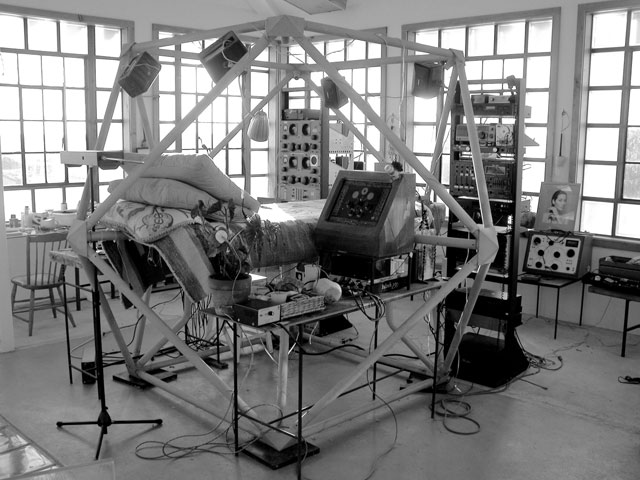
The beacon device as conceived of here provides a method of creating a variety of experiments aimed toward the detection of signals emanating from a broad spectrum of nature intelligence. These signals were brought to our attention during an interview with semiotics expert and brain researcher John Norseen, the subject of Duncan Laurie’s book, “Outlaw Technology”.
Norseen tells of sailors aboard nuclear submarines detecting mysterious signals swarming the surface of the subs, in the range of 7 to 16 Hz, a spectrum within which the subs were monitoring. These signals seemed most intense in geographical areas where numbers of people had died recently and un-naturally.
Norseen stated that military intelligence experts who studied the phenomenon noticed that the appearance of these signals near the subs led to an increase of bandwidth in the perceptual capacity of the communications operators monitoring the strange signals. This increased bandwidth was subjectively experienced as heightened psychic sensitivity, spontaneous remote viewing and other short term PK events.
We took Norseen’s story at face value and decided to design an apparatus that would attempt to mimic the circumstances aboard the subs as described by Norseen. Output from any detected effects would then be sonified or used creatively in computer processing. These effects would add to our inventory of other-worldly sounds and potentially provide a bridge for further communication.
Bat Box II: This smaller, more portable version of B.B. I , also designed and made by Gordon was conceived of by Laurie as an instrument called the "Scratch Glove". A small microphone extension was worn on the wrist (not pictured) that enabled the user to gently rub their fingers together, producing a very vivid 'scratch' sound not unlike that of a needle scraping a record on a turntable. Depending upon the finger motion, syncopation and many nuanced scratch sounds could thereby be produced. We envisioned this device also having other sonic instrumental potential given the extensively varied nature of ultrasonic signals, few of which have ever been explored for this purpose.
Bat Box 1: This invention was conceived and designed by Gordon Salisbury for exploring the sonic spectrum of ultrasound, of which bat radar pulses are a part.
continue reading...
Wearable Art Device:
"Radionic Socks "
Ozone Design Inc. , 224 W 29th St, NY, NY 10001.
Two dimensional radionic circuits incorporated into socks with radionic tattoos allow the wearer to perform radionic operations with applied intent.
THEORY
Some years ago I ran across a website which described an effort to prove the healing power of a cat’s purr. It seems that some nursing home patients were enjoying weekly show and tell sessions involving pets. Volunteers would bring their pets to the home and let the patients hold and pet them (the pets, that is). Someone noticed that those patients who had held purring cats appeared more relaxed and indeed, it was determined that their blood pressure and cardiac rates were lowered as a result of holding the cat. Some believe that powerful healing frequencies and vibrations exist in the near infrasound region. These frequencies exist in a spectrum where signals may be both heard and physically felt. Even low levels of infra-sound are tangible as well as audible.
The purr generator is a device which generates a signal at approximately 25 Hz. This coincides with the frequency of vibrations given off by a “happy cat” and has long been thought to be therapeutic. People holding a purring cat experience a sense of relaxation and well being as the cat’s purr vibrations are transmitted to the person’s body and ears. A second channel similar to the one described above is also provided. This second channel differs from the first in that it may be offset in frequency by approximately +/- 2 Hz. The adjustment for that offset is referred to as the DEPTH control and when properly adjusted can provide a dramatic spatial effect along with the intense heterodyne products in the 0 – 2 Hz range.
Each channel is provided with a switch which allows selection between the normal purr frequency and a variable pitch high frequency generator. When HF is selected, the output of the selected channel can vary from approximately 20 Hz to over 900 Hz. Either or both channels may be operated in HF mode, and the pitch controls may be adjusted for different spatial effects as desired.